Route, seasons and what you see
Bernina Express best time to go
The route in the order you ride it, what each season changes and what to pack, checked against the Rhaetian Railway, UNESCO and Switzerland Tourism.
See Bernina Express day trips on GetYourGuide ↗Quick answer
A clear day matters more than the month. The Bernina line runs all year, and what changes by season is the snow on the pass. On the Milan day tour the train runs south from St Moritz, over the summit at 2,253 metres, past Alp Grüm and down through the Val Poschiavo and the Brusio spiral to Tirano. The train ride is afternoon, so from late October to late February earlier sunsets can cut into the view.
The route, in the order you ride it
On this tour the train runs south. It leaves St Moritz at about 1,775 metres, passes Pontresina and Morteratsch, climbs to the summit at Ospizio Bernina, then descends through Alp Grüm, Poschiavo and Brusio to Tirano, about 430 metres above sea level. The Bernina line is around 61 km long. RhB gives the St Moritz to Tirano ride on the Bernina Express as about 2 hours 15 minutes, so the train is only one part of a long day with coaches at both ends. The railway was built partly to serve hydro-electric plants south of the pass and partly to bring visitors into the high mountains, and it still carries freight as well as passengers.
Morteratsch and the climb
After Pontresina the line turns south-east and reaches Morteratsch station, below the Morteratsch glacier, then passes the Montebello curve, where the railway meets the pass road. Above this stretch rises the Bernina massif, whose highest peak, Piz Bernina, tops the Eastern Alps. The glacier is among the largest in the Bernina range, and its ice front, which once stood near the station, has retreated since. Bernina Diavolezza, a stop for a cable car, follows. Beyond it the line runs above the tree line, through open, high ground, towards the summit.
The summit: Ospizio Bernina and Lago Bianco
The line tops out at Ospizio Bernina, 2,253 metres above sea level, the highest railway crossing in Europe and the highest adhesion railway on the continent. Gradients reach 7 percent with no rack rail. Beside the track lies Lago Bianco, a reservoir formed by two dams in the early 20th century. The pass sits on the great watershed between rivers that flow north to the Inn and those that flow south towards the Po, so the train crosses from one side of Europe's drainage to the other.
Read next: How the Bernina Line Climbs the Alps
Alp Grüm and the Palü glacier
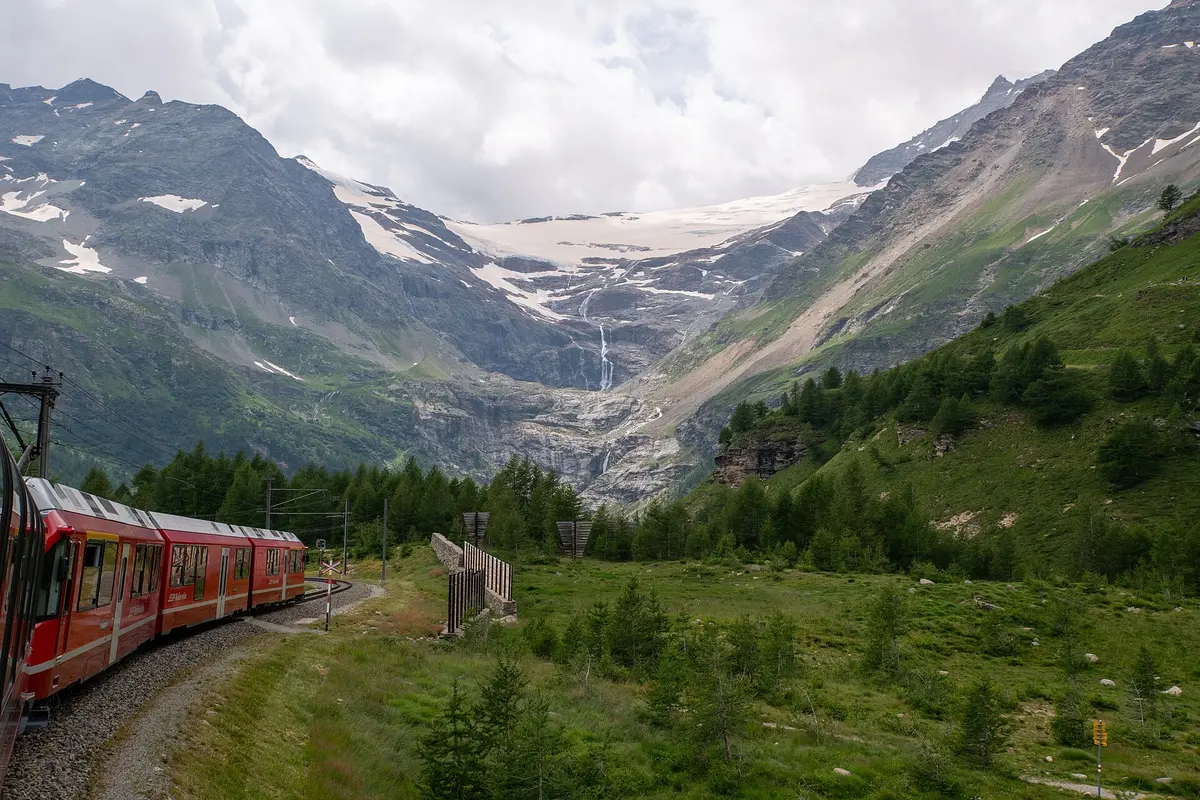
Past the summit the line reaches Alp Grüm, which sits at the tree line, above Lago Palü and right below Piz Palü and its glacier. RhB lists the Palü glacier among the highlights of the route. From Alp Grüm you look down towards the Italian-speaking Val Poschiavo. Below it the line drops through tight 180-degree bends and several half-circle loops, still at gradients of up to 7 percent. The Bernina line ranks among the steepest adhesion railways in the world.
The Brusio spiral viaduct
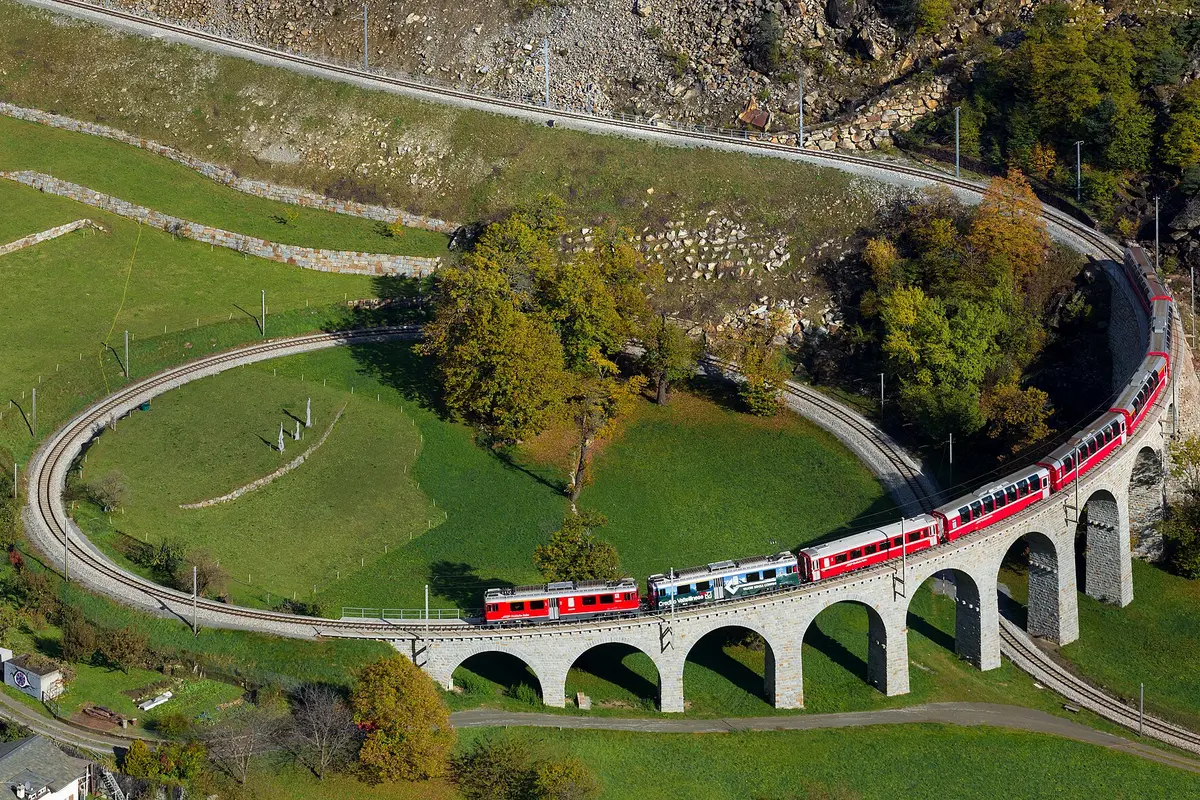
Near the end of the descent, just south of the village of Brusio, the line makes a full 360-degree loop over a curved stone viaduct. It dates from the early 20th century and was built to keep the gradient within the line's 7 percent maximum where the valley falls away steeply. A spiral tunnel had been considered, but local geology discouraged it. The viaduct is about 110 metres long and is counted among the Rhaetian Railway's architectural highlights. You reach it after Lake Poschiavo, so it comes late in the ride, when you are close to the end of the descent. It is a good moment to put the phone away and watch the curve from your window.
The valley, the border and Tirano
Below Alp Grüm the line enters the Val Poschiavo, a Swiss valley where Italian is spoken. The train passes Poschiavo and runs beside Lake Poschiavo before the Brusio spiral. Campocologno is the last Swiss station, and the line crosses into Italy shortly afterwards. Tirano is the terminus, and there the Swiss narrow-gauge line meets the Italian state railway. Keep your passport or ID card with you, because the tour crosses the Swiss border. The Italian side is where the day turns back towards Milan, with a short stop in Tirano before the coach.
Which season?
The Bernina line runs all year. It was first meant as a summer line, but winter operation began in the early 1910s, and snow ploughs, some of them historic, keep it open through the cold months. Snow lies on the pass for much of the year, and the railway is built and equipped to keep running through it. Season therefore changes how much snow lies on the pass, not whether the train runs. Engineering works can divert trains for a few weeks, and RhB posts notices on its Bernina Express page, so check it before you book a date near any announced works.
Daylight and the afternoon train
This tour rides the train in the afternoon. From late October to late February, earlier sunsets can reduce what you see from the windows late in the ride. In spring and autumn, some shops and restaurants in St Moritz keep reduced hours between seasons. Summer avoids both problems, while winter and the shoulder seasons each bring one. Cloud decides the view more than the calendar does, and a clear day in November can beat a grey one in July.
What to bring and how the train helps
Bring a passport or ID card, comfortable walking shoes and a light layer, because Alpine weather changes quickly and the pass is far higher than Milan. Food is not allowed in the tour coach, so eat before you board. If on-board services such as Wi-Fi matter to you, check RhB's Bernina Express page before you travel rather than counting on them. The panoramic cars give the widest view, but seats on this tour are not assigned in advance, so do not count on a particular side. On a tour with a fixed order of stops, the useful habit is to travel light and keep your passport, phone and a drink in a small bag.
Read next: Bernina Express tickets & seats
Your time in St Moritz
St Moritz sits at about 1,800 metres in the Engadine, beside a lake. A hotelier's wager in 1864 is credited with starting winter tourism in St Moritz, and the town has hosted the Winter Olympics twice. On this tour the free time is short, and some options replace it with a lunch at Diavolezza. Plan a walk by the lake and something to eat, as the itinerary suggests, not a full visit. Meals and personal expenses there are not included, so decide beforehand whether you will eat in town or bring food from Milan to eat before the coach.
Who this isn't for
If you get motion sickness, have a heart problem or have limited mobility, this tour is listed as unsuitable, and the coach legs are long. If you want to linger in the mountains, a longer stay in the Engadine suits you better than a day from Milan. If you only want the railway, the line can also be ridden without the coach legs. And if clear views are essential, keep your date flexible, book a date that can be cancelled, and watch the forecast for the pass and for St Moritz.
Frequently asked questions
When is the best time to ride the Bernina Express?
A clear day matters more than the month. The line runs all year, and snow at the pass in winter changes the scene. On this tour the train runs in the afternoon, and from late October to late February earlier sunsets can reduce the view late in the ride.
Does the Bernina Express run in winter?
Yes. The Bernina line operates all year, with winter service since the early 1910s, and snow ploughs keep it open. RhB posts any engineering-work diversions on its Bernina Express page, so check it before you travel.
How long is the train ride from St Moritz to Tirano?
RhB gives about 2 hours 15 minutes on the Bernina Express. The full Chur to Tirano route takes about 4 hours. On the Milan tour you ride only the St Moritz to Tirano section, with coaches before and after.
What is the highest point on the route?
Ospizio Bernina, at 2,253 metres, beside Lago Bianco. It is the summit of the Bernina line, which UNESCO lists together with the Albula line as a World Heritage Site since 2008.
Do I need a passport on this tour?
Yes. Carry a passport or valid ID card for the border between Switzerland and Italy. The line crosses it near Campocologno, shortly before Tirano.
How many bridges and tunnels does the line have?
On the full Chur to Tirano route RhB counts 196 bridges and 55 tunnels. UNESCO lists the Bernina line itself, the part you ride from St Moritz, with 13 tunnels and galleries and 52 viaducts and bridges.
Sources